

Ireland Can't Stop Thinking About Israel
Irish fans stopped a friendly against Qatar to protest a team that wasn’t even there. What they did says more about Ireland than about Israel.

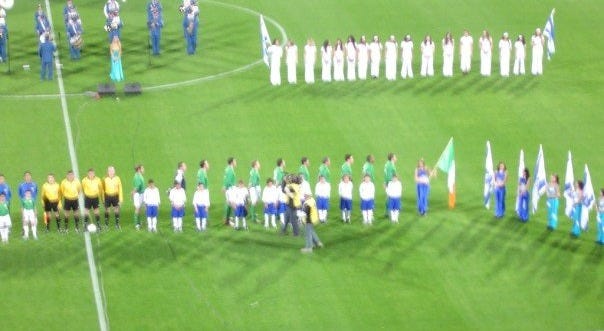
I watch a lot of soccer, enough that I’m trying to talk my wife into letting me fly to the World Cup this summer. I had never seen a game interrupted by a protest against a country that wasn’t on the pitch. That changed Thursday night in Dublin at the Aviva Stadium. Ten minutes in, the game stopped. Tennis balls came down from the upper tiers, each one printed with a Palestinian flag, and the players stood around on the grass while stewards picked them up. It happened again at twenty minutes, and on and off through the first half.
“Free Palestine,” the crowd chanted. “Stop the game.”
The chants were not spontaneous. Supporters’ groups from across Ireland planned them. The point of it was a match that hasn’t yet been played. Ireland is scheduled to play Israel in the UEFA Nations League in late September, and again in Dublin on October 4th.
The opponent that night was Qatar. Let’s sit with that for a second.
Qatar built its World Cup on migrant workers it treated as disposable, with thousands dying in the years of construction leading up to the tournament. Qatar jails people for being gay and spent more than a decade hosting Hamas's political leadership in Doha. No tennis balls for any of that. Nobody was there to protest Qatar. The target was Israel, a team that won’t arrive for another four months.
At first, I thought it was only in the stands. I was wrong. After the final whistle, RTÉ’s post-match pundit Richie Sadlier, a former Ireland international, stood pitch-side and called the coming fixture against Israel a meeting with a country guilty of “the worst crimes imaginable,” in the middle, he said, of a years-long genocidal campaign.
The opponent on Thursday night was Qatar. This is what RTÉ’s post-match coverage chose to talk about. (Source: RTÉ2)
He couldn’t understand how refusing to play Israel had become a controversial position rather than the obvious one. This is the national public broadcaster, which has impartiality duties written into law, treating one of the most bitterly contested questions on earth as a matter of fact.
Consider the phrase itself: “the worst crimes imaginable.” The ceiling of everything human beings have ever done to one another, delivered from the pitch between bits of team news. You can think the war in Gaza a catastrophe and still notice that this is not a sentence a serious person says about it. Rwanda killed eight hundred thousand people in a hundred days. The Khmer Rouge emptied the cities and buried more than a fifth of the country. Those are the things the words were built for. A phrase of that magnitude, presented as the only reasonable view to describe the Israeli-Palestinian conflict, is a symptom of what Irish discourse on Israel has become.
The framing leaves out something larger still. The war Sadlier was describing began on a morning: the 7th of October 2023, when Hamas crossed the border and killed about twelve hundred people in a day. It was the worst massacre of Jews since the Holocaust, and took some two hundred and fifty more into Gaza as hostages. Hamas killed innocent Jews and Arabs that day. None of that reaches the studio or the stands. The story being told in Dublin starts in the middle, with Israel already the aggressor and the dead of that morning written out of it.
Look at what he was actually objecting to, though. Not a policy. A flag hanging from a pole, an anthem coming over the speakers, some Israeli fans in a block of seats, an official obliged to shake a hand. There’s nothing on that list an Israeli government could change to make it stop, because none of it is about what Israel does. You can’t repeal an anthem. Whatever you make of the war in Gaza, keeping those people out of the stadium doesn’t reach anyone in Jerusalem. It reaches the Israelis who showed up — the players, who don’t set policy, and the fans, who bought tickets to a soccer match.
And it goes well past soccer. When the European Broadcasting Union cleared Israel to compete in this year’s Eurovision, RTÉ said it would neither enter nor broadcast the thing, and it followed through. On the night of the final last month, instead of showing a song contest with Israel in it, the broadcaster ran an old episode of Father Ted. Spain and Slovenia did versions of the same. Set the politics aside and it’s still a strange thing to do — pull a song contest off the air, deny it to your own viewers, over one country out of thirty-odd. Same logic as the stadium. The problem was that Israel would be on the screen.
Here’s the part that should give the whole thing away. In Israel, almost nobody is talking about any of this. The game is not important. Around the same time Israel will head into its first national election since the October 7th attacks. The vote must be held by October 27. It is the election that turns on the war and everything after it, and the two games against Ireland fall in the same stretch of weeks. Israelis have a government to choose; a soccer result in Dublin is nowhere near the top of the list. The obsession runs in only one direction. And it isn’t even a game that matters: Ireland’s team just failed, again, to reach a World Cup, throwing away a two-goal lead to Czechia in the playoff and going out on penalties. The game is not important for them either. The protest is the closest thing to an occasion.
Ireland comes by its sympathies honestly, and it has a real record on this kind of thing. It was early and loud against apartheid South Africa. The Dunnes Stores workers who refused to handle South African produce in the eighties are still a point of national pride, and should be. Ireland can plainly do principled solidarity. The puzzle is why the principle only ever switches on for one country. Sudan is living through one of the worst famines of the century, run by its own warring generals, and there are no tennis balls. No blackout for Syria, or Yemen, or the Uyghurs in Chinese camps. It’s Israel that fills the Dáil’s order paper and the studio panels and the cheap seats, and nothing else gets close. The usual reply is that this is whataboutism, that Gaza is terrible no matter what’s happening in Khartoum, and that’s fair as far as it goes. But a conscience that only ever wakes for one country has stopped keeping track of suffering. It’s picked a side and called it a principle.
So why Israel and not everywhere else? The answer has less to do with Gaza than with Ireland. The Palestinian story fits the Irish self-image almost exactly, and Ireland reads the conflict through its own: a small people carved up by a far bigger neighbor, fighting a long war for independence. It is Ireland’s story, projected onto a map of the Middle East. Taking up the Palestinian cause lets the Irish feel like the clean-handed underdog all over again, accurate or not, on the flattering side of an anti-colonial story, and it costs nothing, because the whole thing is unfolding a couple of thousand miles away. A society that prides itself on having grown out of tribal, us-and-them politics gets to indulge in exactly that, and to feel righteous doing it, as long as the stakes stay safely abroad.
That version of the story needs Israel to be a particular thing: a European implant, a settler state with no roots in the region. So let me tell you about a soccer match.
I love this game, and I’ve loved it my whole life. One of the matches I remember best I was at in person: Ramat Gan, 2005, Ireland in town for a World Cup qualifier. I went with my father, who was born in Israel only because his parents had been thrown out of Iraq, with my uncle, who’d been driven out of Morocco, and with two of my cousins. In the final minute, Israel a breath from throwing its campaign away, Abbas Suan collected the ball outside the box and put it in the bottom corner. One-all. The game was tied and the stadium erupted. Suan is an Arab, from Sakhnin in the Galilee. That night the five of us were on our feet with forty thousand other Jews and Arabs together, roaring his name. Sports Illustrated called him the Arab who saved Israel.
That team didn’t make it to the World Cup in Germany that year. It went the whole campaign unbeaten and still missed out, level on points with Switzerland, edged out of the playoff place only on goal difference. It finished above Ireland that year, for whatever that’s worth now. And it was in the European qualifiers at all only because it had been thrown out of Asian soccer in the seventies, when Arab states refused to share a group with it. For most of the next two decades it belonged to no confederation at all, and ended up playing World Cup qualifiers in Oceania, flying to Australia and New Zealand to find teams willing to take the field against it. Israel hasn’t reached a World Cup since 1970. The team Ireland is so set on keeping off its grass has spent half a century trying to be let onto a pitch.
None of which fits the story being told in Dublin, the one that needs Israel to be the colonizer. About half of Israel’s Jews come from families like mine, expelled from an Arab world their ancestors had lived in for thousands of years. Most of the rest descend from people who fled European persecution, the pogroms and then the Holocaust.
The flag the Irish crowd wants pulled down off the pole is the flag of the country that took my family in when Iraq and Morocco were done with them.
In four months those Israeli players, who had no hand in any of it, will walk out at the Aviva under that flag and that anthem, into a stadium that has already decided what they are. Ireland’s president, Catherine Connolly, elected last year in a landslide, has called Israel a terrorist state and accused it of genocide; if protocol requires it, she may be the one made to shake their hands. The country will tell itself it stood that night with the powerless, and it will feel the glow of having done so.
That glow is the whole return, because nothing here was ever going to move a thing in Gaza, and everyone in the ground knows it. What it buys is the feeling of being righteous, brave, on the right side of history — at the going rate of a few tennis balls and a withheld handshake. The bill is paid by the players themselves, half of them descended from Jews expelled from the Arab world, some of them Arab citizens of Israel. They will play for the state Dublin has cast as a colonizer. Strip away the talk of Gaza and what is left is a nation in love with the sound of its own conscience, indifferent to whether the story is even true, and grateful to have found somewhere cheap and far away to perform it.
It's also a whitewash for Irish anti-semitism.
The obsession with a situation thousands of miles away is not unique to Ireland, although it is (sorta) easy to understand their identification with the Palestinians.given their national, strong victimhood self-image.
Want to take the by or automatic loss because you don't want Israel to play in Ireland? Fine. Israel isn't going to voluntarily not play because the game will be disrupted by tennis balls--that's for the Irish to figure out. The Irish need to decide--do they want to play the Israelis or take a by or automatic loss everytime the Irish are scheduled to play the Israelis?
And it's pure antisemiticism because it is singling out Israel while there are so many other "examples" Ireland isn't protesting. But that's a dynamic going on in so many countries.