

Leaving the Table
Sam Harris and Peter Beinart walk out on the Israel argument none of us can afford to leave.

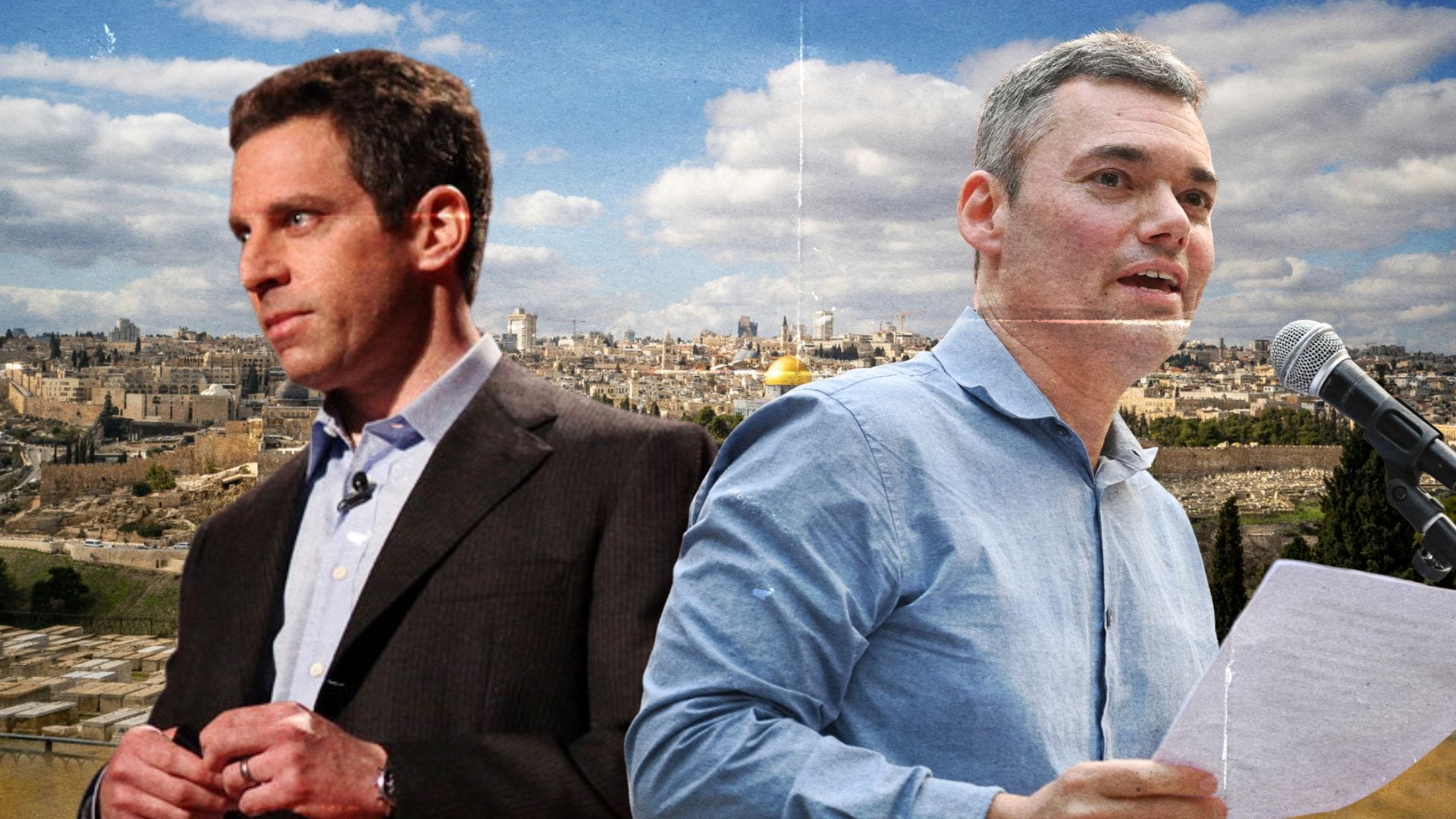
There’s an argument about Israel that has to be kept going, and almost nobody can stand to keep having it. Stripped down, it is simple: is Israel the side you defend or the side you condemn? The honest answer offers no easy choice. This makes it unbearable. There is no clear side to take. You never get to be proven right.
Eventually, most people find a way out. Some decide the answer is settled and stop listening. Some check out completely, decide the cause is lost and argue only to bury it. Either way, the relief is real, and I have felt it. Over the past week, from opposite ends, two of the most prominent voices in the argument showed how good that relief feels.
Sam Harris wrote an essay explaining why he won’t debate critics of Israel. Peter Beinart answered with a monologue explaining why he should. Their views could hardly be further apart, and they reached the same exit through opposite doors. One won’t come to the table with anyone who disagrees. The other sits down only to flip it.
Start with Harris, because I’ve read him for years and admire him. His reputation rests on one habit. He follows an argument to its end, takes on the strongest version of the other side, and treats his own certainty as the first thing that needs checking. On the subject of Israel, he does none of it.
He won’t take up the history, he says, because it’s “irrelevant to resolving the conflict,” and what matters now is something “everyone knows... to a moral certainty.” Strange, coming from him. Interrogating exactly that kind of certainty is the thing he has spent a career teaching the rest of us to do.
And he stops looking. A national movement with a century of secular, Christian, and Marxist strands he flattens into a single concept expressed five times over: “jihadism, Islamism, Islamic extremism, Islamofascism, militant Islam.” Those strands are real, and in Hamas the most violent of them now governs Gaza, but they were never the whole movement, and Harris writes as though they were. Salam Fayyad might as well never have governed. Israel’s current government’s open drive to annex the West Bank is a footnote.
Harris reads the verdict off what each society celebrates, what it is willing to die for and let its children die for. If Israelis ever came to resemble Palestinians, he writes, if Tel Aviv celebrated martyrdom and its crowds gathered “baying for their blood,” then he wouldn’t care who won the war. No Israeli crowd dances over dead children, and for him that settles it.
Last month, I wrote about pro-Israel accounts posting marathons and birthday parties from Gaza as proof there was no genocide. Life goes on, the kids have cake, where’s the genocide? Where’s the famine? Whatever a marathon shows, it isn’t what is happening behind it. If they are selling fruit at a market in Rafah, it says nothing about what is happening in northern Gaza. I reject the genocide charge. But you don’t reject it by holding up a birthday photo, and Harris doesn’t close the moral question by noting that Israelis aren’t suicide bombers. When I went after people on my own side for this, I meant it, and I won’t pretend I don’t recognize it when a man I respect does the reverse.
If the Palestinians put down their weapons, he writes, there would be peace; if Israel put down its weapons, “there would be a genocide.” Under the swagger, the question is fair: what would each side do if it could do anything it wanted. Hamas has answered, in words and in deeds, and it remains one of the most popular factions among the people it governs, the part the other side keeps hurrying past. Harris is right that the question matters. Where he goes wrong is in what he lets it excuse. One true and ugly fact does not free you from the rest, and the one he found is the one that let him stop. He called the stopping clarity.
The test only runs one way for him. The figures at the edge of this government have answered it too, in words and in deeds. One of its ministers, Amichai Eliyahu, floated dropping a nuclear bomb on Gaza and said there were no innocents to spare. After settlers burned Huwara and left one man dead, Smotrich said the state should wipe the town out. Ben Gvir built a career on deciding who belongs on the land and who does not. Harris does not ignore them. He grants Israel has its fanatics, then sets them aside as less representative than the other side’s. That is hard to sustain about men who hold key ministries in Israel’s government. The fringe he describes is one the country elected and put in power.
He is right about the double standard, too. The world scrutinizes Israel as it never scrutinizes Sudan or Yemen and calls the difference antisemitism. The half he skips is that Israel asked to be judged this way, presenting itself as a Western democracy and part of the free world. You get measured against the company you want to keep.
And the refusal is the danger, because of where it points. Harris finds the world’s fixation so unfair, and the answer so obvious, that debating his critics is beneath him. He will make Israel’s case all day, just not to anyone who needs convincing. Harris leaves the door open. He tells his readers to bring better arguments, then prices entry at proving Israel has become as evil as its enemies, a toll built to be paid by no one.
If you strip the philosophy away, what’s left is the line of defense often used by the Ben-Gvir Netanyahu government: all the critics are antisemites, the world is against us, their opinion does not count, so why answer them. Don’t engage. Act, and let them seethe. Arguably one of the most persuasive men alive has reasoned his way to that, and a case made only to people already nodding along changes no one’s mind. He is right that some of the hatred is real. He is wrong that the answer is to leave the table, because leaving is how you lose a fight you could still win.
Beinart caught all this first and caught it well. Harris won’t debate, he says, because he holds his views to be “so self-evidently true” that argument would only waste his time. He’s right about that. But the monologue is its own exit. Everything in it is built to end the conversation.
Harris asked one question. Beinart spent eighteen minutes on everything around it. The West Bank, which isn’t free. The Christians and secular leftists who built the Palestinian movement before Hamas existed. Fayyad, who bet everything on nonviolence and got more settlements for it. All of it true, none of it touching what Harris actually asked. That the Palestinian Authority renounced armed struggle says nothing about what Hamas would do with power, and the movement’s secular and Christian roots say nothing about what Hamas wants now. He keeps winning the fights at the edges, which is how he avoids the one in the middle.
One line gives him away. Peace, he says, can mean nothing more than the absence of conflict, the way Native Americans have peace now, after, in his words, “the Native population was largely destroyed.” Sit with what that comparison does. It makes the peace Israel wants the kind you get once the other people are gone. That is the worst thing you can say about a country, that it is after the disappearance of another people, and Beinart doesn’t quite say it. He buries it in an analogy and moves on before anyone can make him defend it. Which is what he spent the rest of the monologue accusing Harris of doing.
And look at what the comparison has to ignore. The United States never offered the Native nations a state of their own. Israel has offered partition over and over, in 1937, in 1947, at Camp David in 2000, on Olmert’s map in 2008, and every time the Palestinian leadership said no. Argue about how good the offers were, that’s fair. But you can’t square a century of a country repeatedly agreeing to split the land with a secret will to erase the people on the other half. A nation bent on disappearance does not keep proposing a neighbor. Beinart knows this history. He reached for the picture anyway because the argument is on the other side.
His most impressive trick is about legitimacy. Harris says only Israel has to keep arguing for its right to exist. Beinart’s answer is that Washington brands political systems illegitimate all the time, Iran’s, Russia’s, Cuba’s, so there’s nothing special about doing it to Israel. But all of those are governments. When someone calls Putin’s regime illegitimate, they are not saying there should be no Russia. The thing said about Israel, the thing Harris is answering, is that the state should not be there at all. Beinart has to know the difference. His own endpoint is one binational state, which is a way of saying no Jewish state, not a complaint about the one currently running it. He is sneaking a fight about the country’s existence under the language of criticizing its leaders.
Some of his advice to Harris is actually good. Your views aren’t self-evident; go sit with someone who disagrees and risk coming out the other side changed. I agree with this sentiment but he keeps none of it for himself. He will debate, sure; he ends the monologue offering to do it with Harris, the way he has with Dan Shapiro and Coleman Hughes. But he shows up to defend a verdict he has reached long ago. When he spoke at Tel Aviv University last year, he came home and apologized for it, to his own supporters rather than the Israelis he had gone to engage, for the sin of having shown up. The one piece of his own advice he never takes is the part about coming out changed.
For years Beinart held the hard position: a Jewish state and Palestinian freedom in the same breath, no trades. At some point it got too heavy and he set the bigger half down. One state is the lighter load. What’s left once you stop trying to build is the work of tearing down, and he has gotten good at it. I've watched a lot of people pull away from Israel. Beinart is the one who kept going, past the government, past the country, until what he'd left was the idea of a Jewish state at all.
Neither of them will write the one sentence this whole thing demands. Two peoples with real and opposing claims to the same land have to be pulled apart, and getting there means saying Hamas’s aims and this government’s push to annex in the same breath, naming both, not just the one each man already sees. Harris won’t, because the annexation isn’t in the picture he kept. Beinart can’t, because for him two states are already in the ground.
Beinart’s strongest card is Fayyad, and you have to grant it before you can answer it. The most moderate Palestinian leader in a generation staked his whole project on nonviolence, while the Authority’s security forces worked with Israel to put down the Palestinians who kept fighting, and the settlements grew the whole time. He left office calling himself “the address for failure.” Beinart reads that as proof that two states are dead. I read it as something worse. Nobody with leverage ever made Fayyad’s restraint cost Israel a thing, which is why his story indicts the people who abandoned him and not the framework he was testing. He was not defeated so much as left there.
I hold on to both halves for a reason that has nothing to do with principle. Thrown out of Iraq in 1951, my father’s parents reached a transit camp outside Beer Sheva with what they could carry, which was close to nothing. They had lost a country and spent years climbing out of the dust to build another. That is why I can’t pretend the danger Harris points at is invented; my family lived through what happens when a country decides its minorities were never truly its own. The state that took them in was no fairy tale. It left them in those shacks too long and treated Jews from Arab countries as a problem to be sorted rather than a people to be welcomed. None of that is the equal of what they fled, and I won’t pretend it is. It is only enough to keep me from telling the clean story, the one where we are wronged and never in the wrong. So I hold the whole of it, heavier than either half alone.
Both of them stopped. Harris by refusing to sit at the table, Beinart by sitting down only to clear it, both from the comfort of New York City and California, with no rockets flying overhead and no checkpoints to wait at. The people who don’t get to stop are the ones still holding both things at once, that the danger Harris points at is real and the wrong Beinart points at is real, and holding both means the argument never closes and never lets you feel right about it. I don’t think staying at the table changes how any of this ends. I’m staying anyway. What looks like clarity from the outside is just the exit, and I have watched too many people I trust walk toward it.
The argument laid out in this article is foolish in the extreme because it misses out on the main point that Harris is trying to say; which is namely that the specifics don’t matter when the opponent is Fideistic in their approach. Palestinianism is the ultimate fideistic movement. That’s not to say that there is no truth or point to their claims. Rather it is to say that the major proponents of Palestinianism have no interest in evidence, except as it supports their worldview. That is why Peter Beinart can make his “factual” claims while at the same time calling for a one state solution that literally 90 percent or more of both Israelis and Palestinians oppose.
Beinart is not merely someone who shouldn’t be debated, he isn’t worth debating. He is a profoundly disturbed person who would cast his own people back to 1939, stateless and defenseless. This is not someone who deserves to be taken seriously. For reasons that are known only to himself, he has decided that trading the safety, security and sovereignty of his own people is somehow worth it if his far left pals approve. He should not be given any sort of platform from which to advocate such nonsense and, frankly, the rest of us should resolve to never tolerate him in any forum.